

Overview › Design guide › Alternating treatments
Alternating treatments and multielement designs
Alternate two or more conditions rapidly, often session by session, and compare their data paths. A functional analysis is a multielement design.
You will be able to
- Explain how rapid alternation shows experimental control, and when to use the adapted design to compare ways of teaching skills.
- Judge whether a functional analysis is differentiated by comparing each test condition with play.
- Decide whether alternating treatments graphs show control and whether functional analyses are differentiated, reaching 8 of your last 10 in the practice.
How it shows control
Every switch between conditions is a chance to see the difference again. If one condition's data path stays clearly above or below the other's through many alternations, the difference is replicated each time. Separation without overlap is the key feature. Counterbalance the order of conditions, and give each condition a distinct cue, so the order can't explain the difference.
The logic of this design in more depth, its judgment calls and exceptions, and a knowledge check: Visual analysis Lesson 3, Part D.
Minimum standards
- Five repetitions of the alternating sequence to meet the WWC pilot standards, or four to meet them with reservations.
- Either at least three alternating conditions compared with a baseline, or two conditions compared with each other.
What experimental control looks like
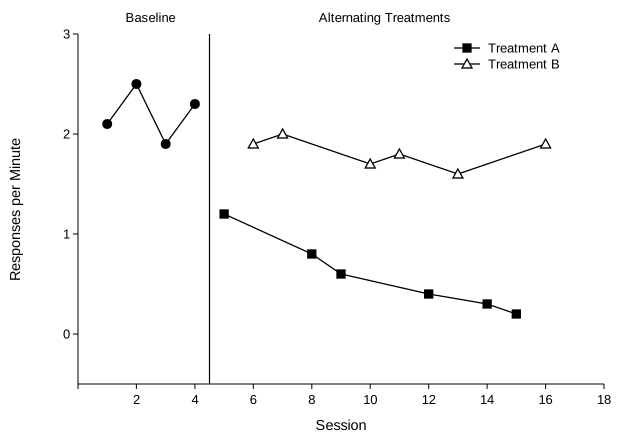
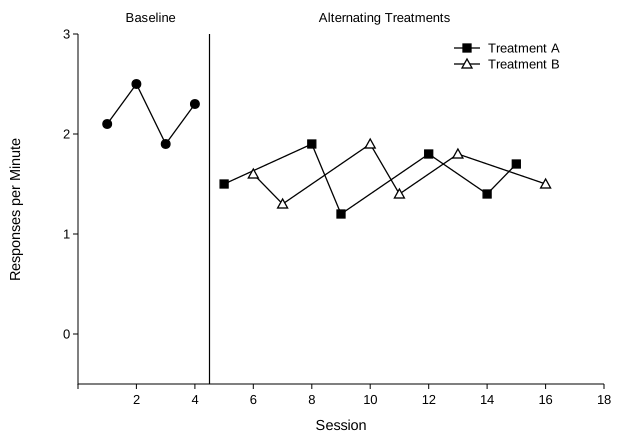
Comparing ways to teach skills: the adapted design
The standard design needs behavior that can rise and fall from session to session. A skill, once learned, stays learned, so two teaching procedures can't take turns on the same targets. The adapted alternating treatments design gives each procedure its own targets instead (Sindelar et al., 1985).
- Equate the sets. Make one set of targets for each procedure, such as sight words or math facts. Match the sets for size and difficulty, for example by length or by pretest errors, and make sure learning one set won't teach the other.
- Alternate the procedures across sessions, and always teach each set with its own procedure.
- Keep a control set that is tested but never taught. If it stays low, gains in the taught sets came from teaching, not from repeated testing or learning elsewhere.
- Compare efficiency. The main outcome is how many sessions, trials, or minutes of teaching each set needs to reach the mastery criterion, along with errors on the way, not only which data path is higher.
- Replicate the comparison across participants or with new sets of targets. A single comparison can be skewed by sets that weren't truly equal.
Functional analysis: differentiated or not?
In a multielement functional analysis, each social test condition arranges one possible reinforcer, such as attention, escape from demands, or tangibles. The alone condition provides no social consequences at all, and a play condition serves as the control. The analysis is differentiated when responding is consistently higher in one or more test conditions than in play. Compare each test condition with play, not just with the highest condition. A condition only moderately above play still counts when its points sit consistently above play's. When more than one test condition is consistently above play, the behavior may be maintained by more than one reinforcer (multiply controlled). When only the alone condition is consistently above play, the behavior may produce its own reinforcer (automatic reinforcement). Structured criteria exist for making this judgment reliably (Hagopian et al., 1997).
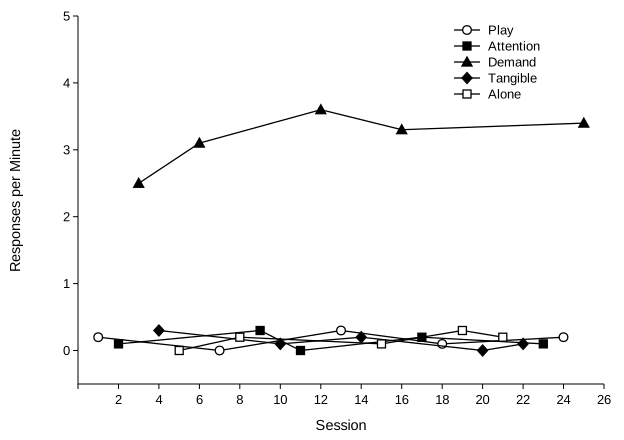
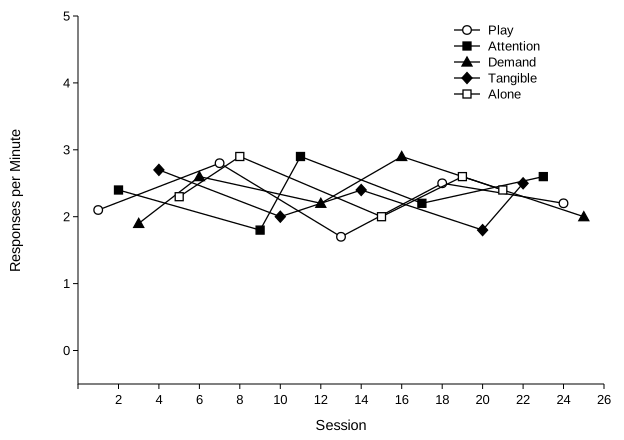
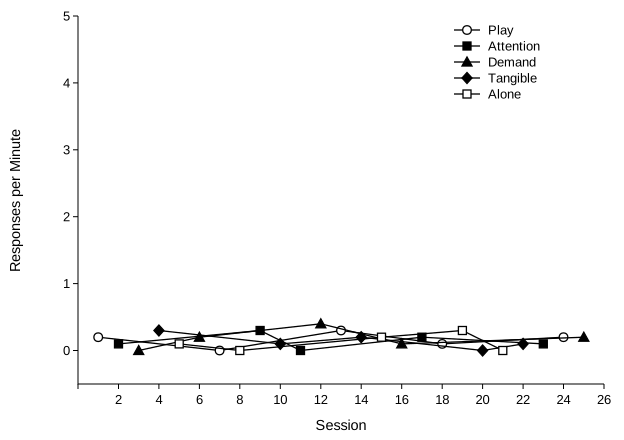
Comparing every test condition with Play, why the demand condition can be capped, and a knowledge check: Visual analysis Lesson 3, Part E.
Practice
Decide whether each alternating treatments graph shows experimental control, and whether each functional analysis is differentiated. Most items then ask a second question: when an alternating treatments graph shows control, which treatment produced less responding; when a functional analysis is differentiated, which test conditions are consistently above Play; and when it isn't, why not. An item counts only when both answers are right.
Graph it
- Template: alternating-treatments.xlsx (all templates)
- Build it by hand: Excel Lessons 1–4 (Excel Lesson 6 recaps the settings)
- Build it with AI: the matching prompt
- For a multielement (functional analysis) graph: the multielement-fa.xlsx template, Excel Lessons 1–4 (Excel Lesson 6 recaps the settings), or the functional analysis prompt